“Crude Oil” also known as “Black Gold” is the thing that makes news, wars are waged for, the thing that humans depend on for their survival, the thing that runs governments across the world and the thing for which governments topple, is undoubtedly THE MOST important thing that is driving the human race forward. Oil is the crucial source of energy to run our planet right now. It is the world's biggest and most pervasive business and 'the' strategic commodity on the world stage. Human beings have created high levels of dependence on oil and now are cursing themselves for what we have done. Several wars starting from targeting Baku’s oil during World war I, caucus mountains during world war II to middle eastern wars of the late 20th century have oil as their prime targets or secondary goals. Oil is also the single largest reason for the revival of America after 1970’s, from the downfall of gold (bullion dollar), when it forged an alliance with the oil producing nations and mark dollar as a single currency for trading their oil (petrodollar). A small jitter across the desert of middle-east would send shockwaves across the whole world within minutes. Markets will crash, people loose their jobs, banks go bankrupt and economy tumbles. That is the kind of dependence on oil right now. Oil is so far the single largest source of energy that has contributed to the astounding evolution of human race all through 20th century.
Oil is similar to blood which is fueling the world. For example, more than 40% of the energy that America consumes (excluding energy from other products like coal) and 99% of fuel for cars and trucks is obtained out of Oil. Similar is the case with many nations. America consumes more oil than it produces. In 2006, America was the third largest producer 8.37 mbd and yet consumed 20.59 mbd. Excluding America, largest consumers who have very low or nil production are Europe, Japan, Canada, Brazil and newly added Asian giants China and India.
As early as 1956, M King Hubbert, a geophysicist in America and worked at Shell Research Lab in Houston, predicted that global oil production would peak and then come down gradually (Hubbert peak theory or Peak Oil). Initially his theory was taken skeptically by most of the oil companies but reality surfaced few years down the line. Now in the 21st century, we know how true that prediction was. In 1930s-40s when oil was extracted from few feet below the ground but now oil companies have to drill thousands of feet to get a decent proportion of oil out to suffice the ever growing need and dependence. The rate of hits in oil exploration is going down gradually and current wells are drying up. Things are not really looking good with respect to oil.
Well! All of us know these facts for sure and that’s why we are seeing this:
“Oil prices rise to record $110 a barrel - Los Angeles Times”
“At the pump, the average national price of a gallon of regular gas rose 2.6 cents overnight to a record $3.758 a gallon, according to AAA and the Oil Price Information Service. – MSNBC.com”
“Retail gasoline prices jumped to yet another record high Sunday. The national average price for a gallon of regular unleaded gasoline edged up to $3.707, topping the previous record of $3.671, set on Friday. Gas prices had been hitting almost daily record highs, most recently running up a 17-day streak that ended May 1. – CNN Money”
“Last week, prices for crude set another record, finishing at $125.96 a barrel on Friday, while gasoline prices closed in on $4 a gallon. – New York Times”
“Crude futures closed higher Tuesday as question marks over Iranian oil production, uncertainty ahead of weekly data on U.S. inventories and a rally in heating oil prices combined to briefly lift oil to uncharted territory near $127 a barrel. – Market Watch”
This is definitely bad news, more bad news:
“With $100-a-barrel here for now, Goldman Sachs says $200 a barrel could be a reality in the not-too-distant future in the case of a "major disruption. – Goldman Sachs” http://www.marketwatch.com/news/story/goldman-sachs-raises-possibility-200/story.aspx?guid=%7B4B702F7F-41F8-45F0-A133-630F12F2C764%7D
“Money Morning Investment Director Keith Fitz-Gerald - one of the first global financial gurus to predict triple-digit oil prices - has boosted his target price for crude oil from $187 to $225.
"The math is really simple here," Fitz-Gerald said in an e-mail interview from China, where he was heading an investment-research tour. "We are burning through supplies at a rate that’s four times to five times faster than we’re discovering new reserves. Throw in a few [surprises] … perhaps a terrorist event …and add in the accelerating use of oil and gasoline in Third World countries, and we have the recipe for far higher prices. That’s already in the oven." http://www.moneymorning.com/2008/05/08/money-morning-boosts-oil-target-price-to-225-a-barrel-thanks-to-continued-scarcity-burgeoning-demand-in-china/
“Oil ends atop $123, up almost 10% in four sessions - U.S. crude supplies climb a third week, but refinery activity declines – Market Watch”
http://www.marketwatch.com/news/story/oil-holds-ground-near-record/story.aspx?guid=%7BEA762176-5AA6-43E6-95E0-1B7C449ADDF4%7D&dist=msr_7
At this moment while I’m writing this blog, the current oil price is $124.22/g. Well as we know that the amount of oil currently available to us is finite and the consumption of oil has been growing, taking into the supply demand ratio, we can come to a conclusion that the price of oil will only shoot up. That’s fine and is acceptable. Let me pool some facts down here. Below is the price chart of oil:
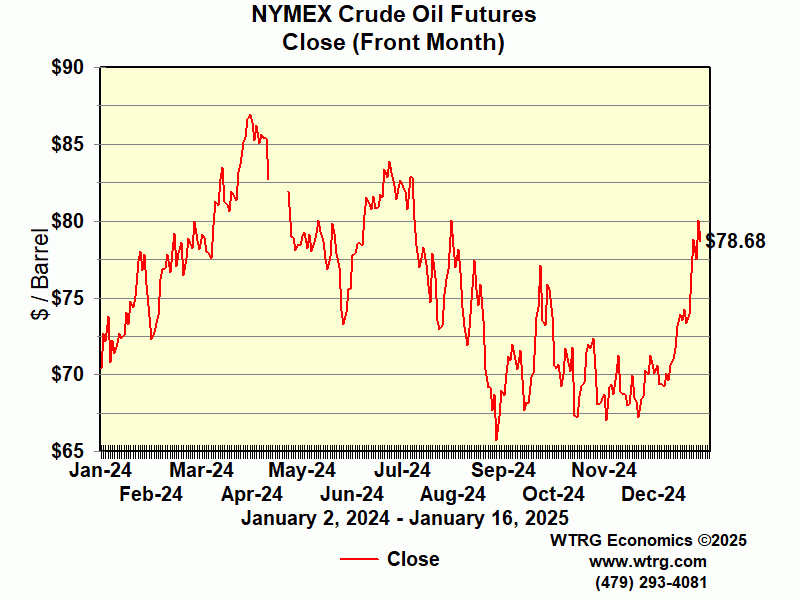
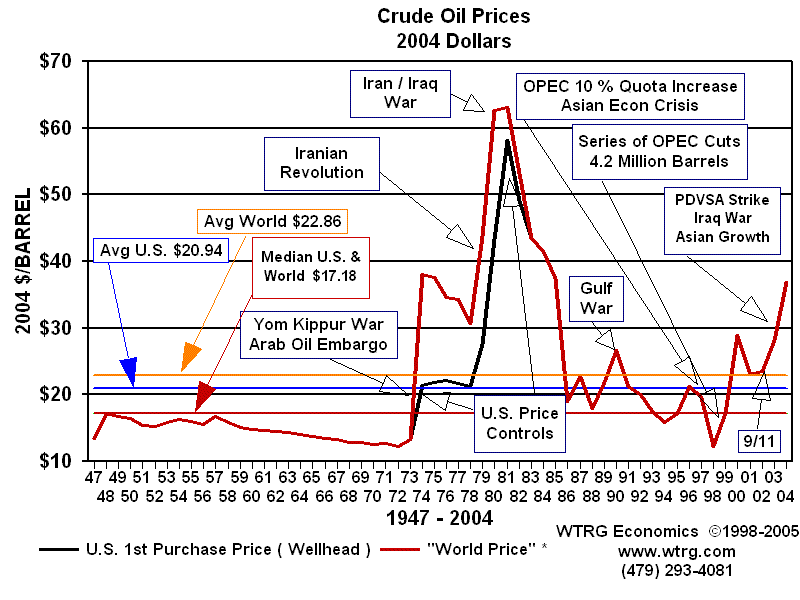
The above chart represents the crude price from the last one year. Below chart represents the price of oil from 1947 to 2007. Data obtained from WRTG economics (http://www.wtrg.com/prices.htm)
Conservative or pessimistic analysts say global oil production from all possible sources, including shale, bitumen and deep-water wells, will peak at around 2015 at about 90 million bpd, allowing a fairly modest increase in consumption. We haven’t reached this peak production yet. There are new oil wells being found and still things look good. We definitely know that our resources are finite but things are still not bad yet. OECD commercial inventories at the end of the first quarter stood at an estimated 2.54 billion barrels, 22 million barrels above the previous 5-year average level. OECD inventories recorded a seasonal decline during the first quarter of roughly 0.3 million bbl/d, about 0.1 million bbl/d less than the average withdrawal rate during the first quarter. EIA’s projected balances suggest that total OECD commercial inventories likely will remain near average levels for the rest of the year.
Let’s take a look at the consumption. Below is the list of Oil consumption by the world from 2000.

Source: http://www.eia.doe.gov/emeu/ipsr/t46.xls
OPEC and non-OPEC supplies look like this:


World oil consumption is projected to grow by 1.2 million bbl/d in 2008 according to EIA (the analytical arm of DOE, US). Below is a chart of the actual figures compiled by EIA. Chart shows the actual consumption, production and inventory as of April 2008 and projections as of 2009.

Full report can be obtained at: http://www.eia.doe.gov/emeu/steo/pub/xls/STEO_m.xls - tab 3atab.
There is some good news here:
“April 9 (Bloomberg) -- Saudi Arabia will start adding 500,000 barrels a day of oil to its total capacity when the Khursaniyah field comes on stream this month, an official at state-run oil company Saudi Aramco said.” http://www.bloomberg.com/apps/news?pid=20601072&sid=adw7Pi4b_a8o&refer=energy
“Since 2000, the largest net increase in estimated proved oil reserves has been made in Canada, with the addition of 174 billion barrels of Canadian oil sands as a conventional reserve.8 Iranian oil reserves have increased by 46.6 billion barrels, or 52 percent, since 2000. Kazakhstan has had the third-largest increase, 24.6 billion barrels, since 2000. – EIA” http://www.eia.doe.gov/oiaf/ieo/oil.html

This summarizes the research that although the consumption has increased, the production has increased too. So the supply and demand are approximately matching up. There are huge reserves and are expected to last a minimum of 50 years if not a century. There is heavy research going on in the alternate fuels and companies/people are increasingly going green trying to use alternate fuels. Use of nuclear energy is also increasing every day.
Further adding to this,
“May 2 (Bloomberg) -- OPEC's second-largest oil producer is storing at least 20 million barrels of crude on 10 double-hull very large crude carriers, or VLCCs, in the Persian Gulf, people familiar with the situation said. That's cutting the supply of vessels that can ship fuel and boosting hire rates.
``There will be some steamy numbers,'' Per Mansson, a tanker broker at Nor Ocean Stockholm AB, said in an e-mailed note today. ``Storage is always good for the market.''
http://www.bloomberg.com/apps/news?pid=newsarchive&sid=a3NcbIsUT8a0
“May 5 (Bloomberg) -- Saudi Aramco, the world's largest state oil company, increased the discount on prices of heavy crudes it will export to Asia in June to a record after the refining profit for fuel oil declined.” http://www.bloomberg.com/apps/news?pid=newsarchive&sid=a8kPtRPG6RMQ
“OPEC won't consider increasing crude output before it meets in September because the market is well supplied, Qatari Oil Minister Abdullah al-Attiyah said.
“Chevron announced that they are drilling more follow-up wells near their Jack and St. Malo discoveries. They also announced the delay of 70,000 b/day production from their Blind Faith project. http://www.energybulletin.net/43727.html
“May 8 (Xinhua) -- General Secretary of the Organization of the Petroleum Exporting Countries (OPEC) Abdullah Salem El-Badri said here on Thursday although the oil prices rose sharply in recent months, there was clearly no oil shortage in the market.”
http://news.xinhuanet.com/english/2008-05/09/content_8132384.htm
During the same period, US has stockpiled lots of oil for its strategic reserves about 12 m barrels in April.
http://tonto.eia.doe.gov/oog/info/twip/twip.asp
“In the United States, there is no longer much doubt that consumers are responding to higher fuel costs by driving less. Oil consumption fell by 3.3 percent in March, compared with March of last year.”
http://www.iht.com/articles/2008/05/14/business/14refine.php
“Oil nears $124 a barrel and gasoline hits $3.65 a gallon, despite a lack of supply-and-demand fundamentals to drive the market. – CNN Money” http://money.cnn.com/2008/05/08/news/economy/oil_prices.ap/index.htm?section=money_markets
So even though the consumption and supply isn’t altered much, why are the oil prices going up north? That is a big question for us now. Here is some news:
“Refining utilization rates, slumped to a low of 81.4 percent in the second week of April, compared with 90.4 percent at the same time last year. Earlier this month, refineries were running at 85 percent of their capacity.” http://www.iht.com/articles/2008/05/14/business/14refine.php
Well this clearly shows that US refineries have slowed down production. This reduces supply in the market and prices soar. Few reasons cited for this high oil prices are:
Weakening dollar
China and India consumption
Nigeria issues
Weakening dollar:
“The market sometimes ignores the dollar, as it did Wednesday when oil surged to new records while the dollar advanced. Some analysts say that's a sign that many investors are buying on pure momentum - believing prices will head higher regardless of negative data, news or dollar movements.” http://money.cnn.com/2008/05/08/news/economy/oil_prices.ap/index.htm?section=money_markets
China and India consumption:
“Analysts at Goldman and firms such as Barclays Capital believe tight global supplies, and growing demand from fast-growing economies in such countries as China and India, are driving oil higher. But Gheit and other analysts, including Tim Evans at Citi Futures Perspective, argue that supply-and-demand fundamentals don't support such high prices”http://money.cnn.com/2008/05/08/news/economy/oil_prices.ap/index.htm?section=money_markets
Nigeria Issues:
“In 2004, Nigeria was rocked by a crisis in the oil industry which, coupled with the continuing problems in Iraq and contracted petrol supplies offered by Saudi Arabia and other OPEC countries, has serious implications for the entire world community. In 2004, world consumption of crude oil is on track to surpass 82 million barrels (13,000,000 m³) per day, 30 billion barrels (4.8 km³) per year. This puts consumption equal to production leaving no surplus capacity.” http://en.wikipedia.org/wiki/Nigerian_Oil_Crisis
From the above reports, its can be inferred that weakening dollar cannot be a barrier for the sudden surge in oil prices and China and India have been consuming more gradually. Both the countries didn’t increase their consumption all of a sudden. Nigeria issues have been there from 2004. What changed in 2008 that the oil price reached the highs after the Oil embargo of Middle East in 1970’s?
Before going into this, let’s see what happened due to this oil price hike and who is benefiting.
“May 2, 2008: Exxon, the world’s largest publicly traded oil company, said its net income rose 17 percent in the first quarter, buoyed by high oil prices. That level of profitability still makes last quarter Exxon’s second most lucrative, after the record $11.7 billion it earned in the fourth quarter of 2007. Last year, the company reported a profit of $40.6 billion, the biggest annual profit by an American company.” http://www.nytimes.com/2008/05/02/business/02oil.html
April 28, 2007 The Chevron Corporation reported an 18 percent increase in first quarter profit as it cashed out of a Netherlands venture and cashed in on lucrative refining margins. Chevron said it earned $4.7 billion, or $2.18 a share, in the quarter, compared with $4 billion, or $1.80 a share, a year earlier. http://query.nytimes.com/gst/fullpage.html?res=9906EED7123EF93BA15757C0A9619C8B63&scp=1&sq=Chevron%27s+profit&st=nyt
April 30, 2008 Higher oil and natural gas prices helped Royal Dutch Shell and BP report record first-quarter profits on Tuesday, beating analysts’ expectations and prompting share gains across the industry. Shell’s net income in the first three months of the year rose 25 percent, to $9.08 billion. BP reported that its profit increased 63 percent, to $7.62 billion. In trading here on Tuesday, shares of Shell and BP rose more than in at least two years. Other oil companies that profited from higher prices included ConocoPhillips, whose first-quarter profit rose 17 percent to $4.14 billion. http://www.nytimes.com/2008/04/30/business/worldbusiness/30oil.html
Well the high oil prices are welcomed by oil companies as they record high profits. Is that the story alone or is there something else wrong out there? I’ll present my view point. Take for e.g. the prediction of Goldman Sachs that Crude oil will reach new highs of $200 a barrel. This prediction from Goldman Sachs sent shockwaves across the market and oil price soared. Well we know that Goldman Sachs was one of the founding partners of online commodities and futures marketplace Intercontinental Exchange (ICE). In 2006, senate investigations revealed that market speculation has contributed to rising oil and gasoline prices, and that too many energy trades are occurring without regulatory oversight (http://www.senate.gov/~levin/newsroom/release.cfm?id=257862). This is a clear example of how corporations are speculating with critical commodities like crude oil for their personal benefits.
Let me drill this, what I call “2008’s Black-Gold ‘black’ crisis” little bit more. I want to take Exxon Mobil as an example. Exxon Mobil made record profits last year and this quarter and is continuing to do so based on record high oil prices. That’s good. Now the real story begins.
State Street Corporation (http://moneycentral.msn.com/companyreport?Symbol=STT), a major financial and asset management company, holds the highest institutional holding in Exxon Mobil. They have 193.2 million shares in XOM (Exxon Mobil). The other huge corporations are Barclays Global Investors (186.1m), Vanguard Group, Inc (166.3m) and Fidelity Management & Research (107.8m). My particular interest for my case study is STT (State Street Corporation). STT is currently trading at 73.09. In the last one year, the stock traded like this:

State Street’s financial issues:
“In January 2008, State Street reported that it is keeping aside $618 million to cover legal costs tied to the company’s foray into sub-prime investments. State Street’s customers lost close to $2.6 billion in three months”. (http://dailybriefing.blogs.fortune.cnn.com/2008/01/03/state-streets-subprime-mess)
More bad news from STT: http://www.marketwatch.com/News/Story/Story.aspx?guid=%7BFF0D7D15-2155-477A-AF0B-0AD7B95A1563%7D&siteid=nwhpm.
“Stephen Rosenberg discusses lawsuits against State Street Corp. by pension funds that say the company improperly invested their money in risky real-estate funds - which could leave the company vulnerable to hundreds of millions of dollars' worth of damages if it loses.” (http://www.universalhub.com/node/14537)
“Millions for Defense, Billions for Damages: State Street's Exposure” (http://www.bostonerisalaw.com/archives/401k-plans-millions-for-defense-billions-for-damages-state-streets-exposure.html)
“State Street Chief Financial Officer Ed Resch said in the company's earnings conference call it suffered a loss of $3.2 billion on its portfolio and a $2.5 billion loss on conduits, according to a transcript of the call on Thomson Street Events.” (http://www.reuters.com/article/fundsNews2/idINN1546338820080415?rpc=77)
This is astounding news to me. Yet STT’s stocks regained although the sub-prime mess didn’t clear the air and STT posted strong profits shrugging off the crisis (http://dailybriefing.blogs.fortune.cnn.com/2008/04/15/state-street-shrugs-off-crisis). STT in Feb made into Goldman Sachs favorite list of good asset management firms even though it had its own losses. Well Goldman Sachs is making some news. Let’s see who has large institutional share in Goldman Sachs, the premier investment banking firm and a leader in the analysis of global market, companies and commodities. Bingo!! STT, Barclays, Vanguard and Fidelity (the same companies holding maximum institutional shares of Exxon Mobil) hold collectively 52 million shares (14%) of Goldman Sachs. Well, almost all of the institutional investors in Goldman Sachs (GS) have good holdings in major oil corporations.
This is why it is relevant when STT says that it follows “S&P GSCI Commodity Index Strategy” for its investment strategy in commodities. STT is basing its strategies for itself and its investors on GS predictions and a guy with half brain can tell that predictions will be in its favor (because it is a major share holder in the company) and market responds critically to these market reports.
Hmm!! Well I’m no expert but things are making sense to me. To me, things are pretty simple. High oil prices correspond to high profits for oil companies which in turn is high profits to investors in those oil companies (like STT). These same companies hold majority stake in research firm Goldman Sachs and thus we are seeing market analysis reports like oil to hit $200 a barrel although the basic dynamics of supply and demand didn’t change.
A little bit of further research from my side lead to still more troubling facts. A simple search of members trading on NYMEX (New York Mercantile Exchange – Commodities trading exchange) gave me a huge list of members who have direct holdings in major oil corporations (for e.g. Barclays Bank PLC, Barclays Capital Inc., Fidelity Investments, Goldman Sachs & Co. and Goldman Sachs & Co. (London) etc). On STT’s website, they claim to have a trading firm to trade in NYMEX (I didn’t research further for the company’s name). All of this looks like a big gamble. And the information I have reported is just for one big company. There are many other huge corporations which have large stakes in major oil corporations and have subsidiaries trading on NYMEX.
From what I understand from this blog is that, investors in oil corporations are running the crude oil price up and down depending on their desire. They have ignored the basic supply-demand structure and driving the prices for their own vested interests. As a consequence of high oil prices recently is leading to a huge spike in food and other commodities. Every major category is affected due to high oil price which is being played by a handful of people in the market and regulators and government (bodies responsible to keep this in check) are sitting silently. There is a possibility of a good nexus between corporations and regulators/Govt (http://www.nytimes.com/2008/05/05/opinion/05mon2.html).
If this is the reality then millions of poor people are suffering for the monitory interests of a handful of large corporations. Major media is also succumbing to the games of these corporations. As we have seen, the wide publicity of the GS prediction of $200 oil. But nobody questioned the ground reality behind that prediction and nobody researched.
Is this whole mess for personal gains? Is this price rise, a big gamble?
Have fun!!!
gatzzz…
PS: I have used the term "Oil" for Crude Oil, Gasoline and/or Petrolium. This blog is my personal view and does not state anybody elses views or comments.


2 comments:
comments???:- long one buddy!!!
Non-invitees are not expected to comment!!
Post a Comment